
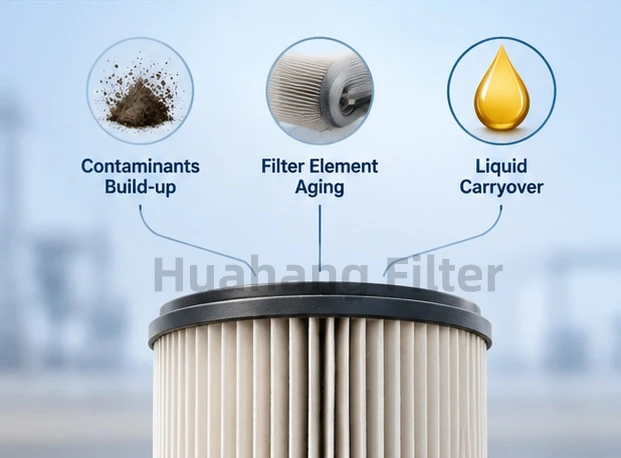
A rising differential pressure (ΔP) reading is the single most useful diagnostic signal in a natural gas filtration system - and the most misunderstood. Operators often treat it as a simple "time to change the cartridge" alarm. In reality, natural gas filter differential pressure tells you what is entering the vessel, how the cartridge is behaving, and whether the whole separation train is working as designed.
If your gas filter pressure drop climbs faster than the commissioning baseline, the cause is rarely just "the filter is dirty." This article explains what drives ΔP up, how black powder, rust and liquid contamination behave differently inside the media, how to tell normal from abnormal pressure drop, when a natural gas filter cartridge actually needs replacing, and how to extend its service life without compromising gas quality.
What Causes High Differential Pressure in Natural Gas Filters?
⭐Solids loading (the normal cause)
Every cartridge has a finite dirt-holding capacity. As particles accumulate on the upstream surface, the flow area shrinks and ΔP rises. In a well-designed system this is a smooth, near-linear curve over weeks or months. Understanding the internal flow path helps here - see how a natural gas filter works .
⭐Liquid loading and media wetting (the underestimated cause)
Water, glycol and hydrocarbon condensate do not simply sit in the sump. When liquid reaches the coalescing media, it fills the pore structure, swells the fibers and dramatically reduces permeability. A cartridge that is only 30% loaded with solids but saturated with liquid can show a higher ΔP than a fully loaded dry one. If the sump drain is blocked or manually operated and forgotten, coalesced liquid is re-entrained and the cycle repeats.
⭐Cartridge micron rating too fine for the duty
Specifying 0.3 μm coalescing media where 5 μm protection would satisfy the downstream equipment is one of the most common causes of premature gas filter pressure drop. Finer media means smaller pores, lower permeability, and much lower dirt-holding capacity. Filtration rating should be driven by the tolerance of the protected equipment (turbine, meter, regulator, compressor), not by "finer is better." Our guide on how to choose a natural gas filter cartridge covers this trade-off in detail.
⭐Undersized cartridge count or flow area
ΔP rises with roughly the square of flow rate. A vessel fitted with too few cartridges, or with shorter elements than the design called for, will run at elevated velocity: higher approach velocity means higher initial ΔP, deeper particle penetration into the media (rather than surface cake formation), and faster clogging. Always size total flow area at 1.2× the maximum instantaneous gas rate.
⭐Flow upsets and transient surges
Peak winter demand, compressor start-up, pigging runs and valve switching all create short flow excursions. ΔP spikes during these events are normal; what matters is whether ΔP returns to baseline afterwards. If it does not, the media has been driven into a compressed, low-permeability state.
⭐Media damage, collapse or migration
A collapsed pleat pack, a torn seam or media migrating downstream reduces effective area and can partially block the outlet path. Typical signature: ΔP rises sharply, then drops suddenly, then rises again - while downstream gas quality gets worse, not better.
⭐Installation errors and internal bypass
Wrong cartridge length, missing or twisted O-rings, or an incorrect end-cap configuration allows gas to bypass the media. This usually produces an abnormally low ΔP together with dirty downstream gas - a combination that is easy to misread as "the filter is fine." Compare end-cap codes against the housing drawing before installation.
⭐Hydrate and ice formation
Wet gas at high pressure and low temperature can form hydrates at the cartridge face or in the outlet core. The signature is a rapid ΔP rise during cold snaps or after shut-in, which disappears once temperature or pressure conditions change.
How Do Black Powder, Rust and Liquid Contamination Affect Filter Performance?
These three contaminants behave very differently, and each produces a distinct ΔP fingerprint.
|
Contaminant |
Typical size |
ΔP behaviour |
Why |
|
Black powder (iron sulfide / iron oxide) |
0.1–10 μm, high surface area |
Rapid rise; ΔP can double in days |
Sub-micron particles form a dense, low-porosity cake on the media surface; the cake itself becomes the filter |
|
Rust, mill scale, welding slag |
25–500 μm |
Slower, steadier rise |
Larger particles are captured in the outer coarse layer; high mass but good permeability |
|
Liquid (water, glycol, condensate) |
Aerosols < 1 μm |
Fast and often erratic; frequent drain cycles |
Liquid fills pores, swells media, and re-entrains when the sump is not drained |
⭐Black powder
Black powder is the dominant contaminant in transmission and distribution networks. Because it is sub-micron and highly porous in bulk but compresses into a tight film under differential pressure, it can take a filter from clean to fully plugged in a fraction of the expected interval. It is also pyrophoric when dried and exposed to air, so cartridges removed from black-powder service must be wetted and handled carefully. For source control and removal strategy, read how to remove black powder from natural gas pipelines .
⭐Rust and pipeline debris
Rust flakes and slag are the "honest" contaminants: they load the outer layer, raise ΔP gradually, and are largely predictable. They are also abrasive - if they reach a regulator or meter, the damage cost far exceeds the cartridge cost. A coarse upstream stage (50–100 μm) captures them cheaply and protects the fine coalescing stage behind it.
⭐Liquid contamination
Water and condensate cause the most misleading ΔP readings. Two mechanisms matter:
- Pore blocking and swelling : liquid in the media reduces gas permeability far more than an equivalent volume of solids.
- Re-entrainment : if coalesced liquid is not continuously drained, high gas velocity lifts it back into the media, restarting the cycle. A cartridge can look "permanently clogged" when the real fault is a stuck drain valve.
This is why gas-phase coalescing elements are built differently from plain particulate cartridges: the media must be oleophobic/hydrophobic enough to release captured liquid rather than hold it, and the element must be paired with a separation stage that lets droplets drain freely.
What Is the Difference Between Normal and Abnormal Pressure Drop?
There is no universal "correct" ΔP number, because it depends on flow rate, gas density, cartridge count and micron rating. What is universal is the shape of the trend.
⭐Normal pressure drop
- A stable baseline after commissioning (commonly in the range of 2–5 psid / 0.015–0.035 MPa for a correctly sized clean element).
- A gradual, roughly linear rise as solids accumulate.
- ΔP that responds predictably to flow changes (rise with flow, fall when flow drops).
- Full restoration to baseline after a cartridge change.
⭐Abnormal pressure drop
|
Symptom |
Most likely cause |
First action |
|
High ΔP immediately after installation |
Wrong micron rating, too few cartridges, wrong length, or flow above design |
Verify part number, count and flow against the datasheet |
|
ΔP doubles within days |
Black powder loading or liquid saturation |
Inspect removed cartridge; check drain and upstream separation |
|
ΔP fluctuating up and down |
Liquid slugs, unstable drain, or hydrate formation |
Check drain operation, gas temperature and dew point |
|
ΔP rises then suddenly falls |
Media rupture or pleat collapse |
Shut down and inspect; test downstream gas quality |
|
Low ΔP but dirty downstream gas |
Internal bypass, missing/rolled O-ring, damaged end cap |
Verify installation and seal integrity |
|
High ΔP only in winter |
Hydrates, condensate or wax formation |
Review insulation, heat tracing and dew point control |
⭐Use trend data, not a single reading
Log ΔP daily along with flow, temperature and pressure. Two derived values are far more useful than the raw number:
- Rate of rise (psid per day) : projects the remaining service life and allows planned, not emergency, change-outs.
- Flow-corrected ΔP : normalise to a reference flow so that a demand spike is not mistaken for clogging.
When Should a Natural Gas Filter Cartridge Be Replaced?
Replace on evidence, not on a calendar. The four accepted triggers are:
- ΔP reaches the change-out limit. Typical practice is to replace at 7–10 psid (0.05–0.07 MPa) for many gas coalescing elements, with 0.12–0.15 MPa treated as a forced-change ceiling. Always defer to the vessel OEM's stated limit for your specific element.
- The rate of rise predicts a breach before the next planned outage. If ΔP is climbing 1 psid per week and you are 6 psid from the limit, schedule the change now.
- Liquid carryover appears downstream. Visible liquid in the sump sample, glycol in the outlet, or rising dew point indicates the coalescing stage has failed regardless of ΔP.
- Mechanical or event-driven replacement. After a compressor trip, pigging run, hydrate event, or any cartridge that has been in service beyond 12 months, replacement is due even if ΔP looks acceptable.
A ΔP gauge alone is not sufficient. Pair it with a visual inspection of the removed element: a uniformly coated cartridge indicates normal solids loading, a partially wet or collapsed one points to a system problem rather than a filter problem. For the operational side of the decision, see is it necessary to replace the natural gas filter.
Conclusion
A rising natural gas filter differential pressure is not a nuisance alarm - it is the system telling you where contamination is coming from and how the filtration train is performing. Read the trend, not the number: a slow linear rise means solids loading; a fast, erratic rise means liquid; a high reading from day one means the system is mis-specified.
Fix the upstream, drain the sump, size for peak flow, and match media to the equipment you are protecting. Do that, and natural gas filter cartridge clogging becomes a planned maintenance item instead of an unplanned shutdown.
Need help diagnosing a pressure drop problem? Send us your flow rate, operating pressure and temperature, current ΔP curve and cartridge part number - our engineers will review the application and recommend the right element, or confirm whether the issue actually sits upstream of the filter.