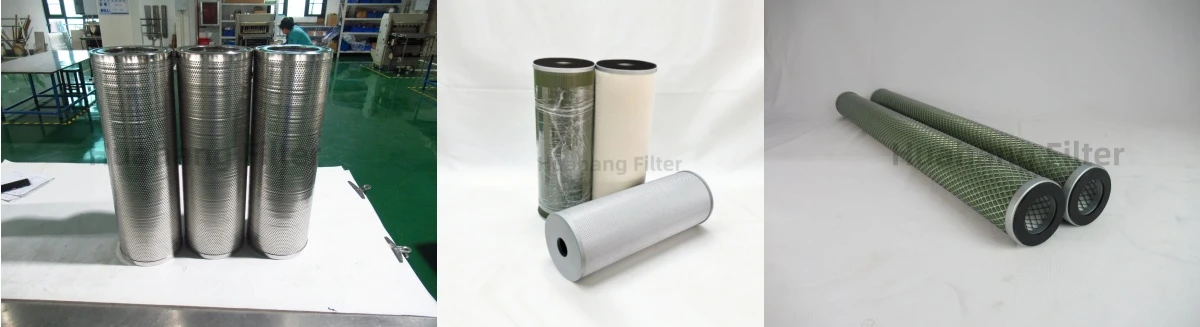
Oil mist separator filter cartridges play an important role in removing oil aerosols from exhaust air and industrial gas streams. They are widely used in vacuum pumps, industrial compressors, lubrication systems, and other equipment that generates oil mist during operation. The filtration performance, service life, and operating stability of these cartridges depend heavily on the filter media used in their construction.
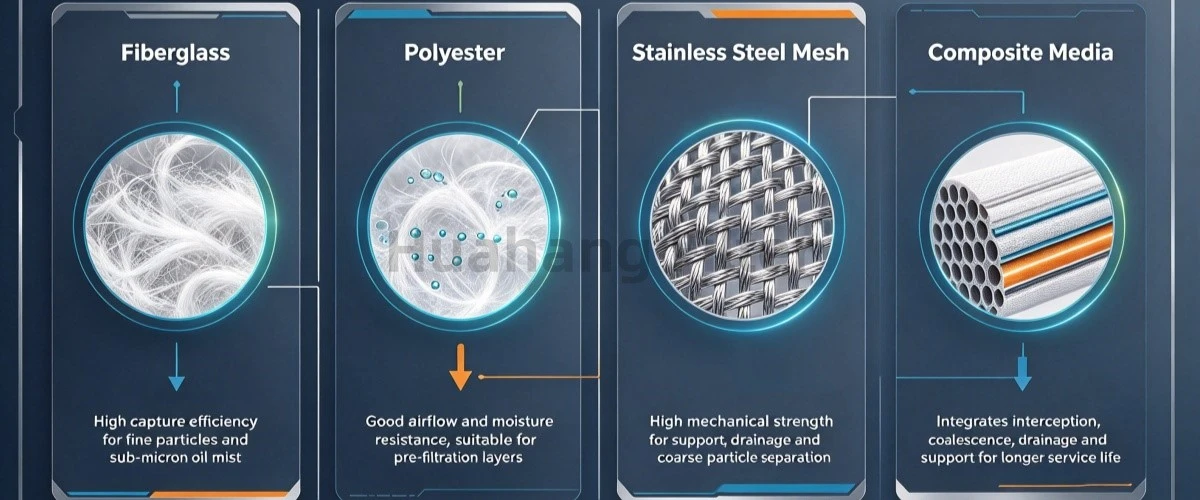
So, what materials are used in oil mist separator filter cartridges? Common options include fiberglass, polyester fiber, polypropylene, stainless steel mesh, and composite filter media. Each material has different filtration characteristics, chemical compatibility, temperature resistance, and structural properties.
Understanding these materials helps equipment manufacturers, maintenance engineers, and industrial buyers select the right oil mist separator filter for their applications.
Why Does Filter Media Matter in Oil Mist Separation?
Oil mist consists of tiny liquid oil droplets suspended in air or gas. These droplets may be generated by high-speed rotating components, lubrication systems, vacuum pumps, and compressed air equipment.
Unlike larger liquid particles, fine oil aerosols are difficult to remove using ordinary mechanical filtration. An effective oil mist separator cartridge needs to capture small droplets, promote their coalescence into larger droplets, and allow the separated oil to drain away.
The filter media directly affects several important performance factors:
- Filtration efficiency: Determines how effectively the cartridge captures oil droplets of different sizes.
- Pressure drop: Influences airflow resistance and the energy required to move gas through the filter.
- Oil compatibility: Determines whether the media can withstand continuous contact with mineral oils, synthetic oils, and other lubricants.
- Temperature resistance: Affects whether the filter can operate reliably under different thermal conditions.
- Service life: Depends on media strength, resistance to degradation, contamination loading, and operating conditions.
- Oil drainage performance: Influences how efficiently coalesced oil moves through the media and returns to the collection area.
Selecting the correct filter material is therefore essential for achieving stable oil mist separation performance.
Common Materials Used in Oil Mist Separator Filter Cartridges
Different oil mist separator cartridges use different filter media depending on the equipment design and operating requirements. The following materials are among the most common options.
| Filter Material | Main Advantages | Main Considerations |
|---|---|---|
| Fiberglass | Fine aerosol capture, high filtration potential | Requires appropriate handling and structural support |
| Polyester (PET) | Mechanical strength, flexible processing | Standard grades may have limited fine aerosol efficiency |
| Stainless Steel Mesh | High strength, temperature resistance, reusable options | Limited fine aerosol capture when used alone |
| Composite Media | Combines multiple performance characteristics | Design and material compatibility are more complex |
There is no universally best material for all oil mist separator filter cartridges. The appropriate choice depends on the required filtration efficiency, operating temperature, oil type, airflow, pressure drop, and equipment design.
How to Choose the Right Material for an Oil Mist Separator Filter Cartridge?
When selecting an oil mist separator filter cartridge, buyers should evaluate more than the material name. The actual media structure and operating conditions are equally important.
⭐Consider the Oil Type
Different lubricants have different chemical compositions and operating characteristics.
For example, mineral oils, synthetic oils, and specialized compressor lubricants may interact differently with polymer-based filter materials and sealing components.
Before choosing a filter medium, confirm its compatibility with the specific oil used in the equipment.
⭐Check the Operating Temperature
Temperature can affect fiber stability, polymer performance, sealing materials, and the overall service life of a filter cartridge.
Fiberglass and stainless steel can be considered for applications requiring higher temperature resistance, while polyester and polypropylene should be selected according to their specific material grades and temperature limits.
Always check the manufacturer's recommended continuous operating temperature rather than relying only on the material's general properties.
⭐Determine the Required Filtration Efficiency
The required filtration efficiency depends on the size distribution of oil aerosols and the allowable residual oil concentration in the outlet gas.
Fine fiberglass media are frequently used for high-efficiency coalescing applications. Stainless steel mesh may be more appropriate for larger droplets or as a support and drainage component.
For demanding applications, a multilayer composite structure may provide a better balance between fine particle capture and airflow resistance.
⭐Evaluate Pressure Drop
A filter cartridge with excessively high airflow resistance can negatively affect equipment performance and increase operating costs.
The media density, fiber diameter, pleat geometry, filtration area, and cartridge dimensions all influence pressure drop.
When selecting an oil mist separator, compare the initial pressure drop and the recommended terminal pressure drop under the intended operating conditions.
⭐Consider Oil Drainage Performance
Capturing oil droplets is only part of the separation process. The coalesced oil must also drain effectively from the filter media.
If oil accumulates inside the media, the cartridge may experience increased pressure drop and reduced filtration performance.
The drainage characteristics of the media, cartridge orientation, internal structure, and housing design should therefore be considered together.
Common Applications of Oil Mist Separator Filter Cartridges
Oil mist separator cartridges are used in various industrial systems where oil aerosols need to be removed from exhaust air or process gas.
Common applications include:
- Vacuum Pumps: Capture oil mist from pump exhaust and reduce oil emissions into the surrounding environment.
- Industrial Compressors: Separate oil aerosols from compressed air streams in suitable filtration systems.
- CNC Machining Equipment: Remove oil mist and coolant aerosols generated during machining processes.
- Lubrication Systems: Control oil mist emissions from equipment using circulating lubricants.
- Industrial Exhaust Systems: Reduce airborne oil aerosol concentrations before treated air is discharged or further processed.
Different applications may require different filter media, cartridge configurations, and separation efficiencies. Selecting a cartridge specifically designed for the equipment is important for reliable operation.
Custom Oil Mist Separator Filter Cartridges from Huahang Filter
Huahang Filter specializes in the design and manufacture of industrial filter elements for various filtration applications. We provide customized filter cartridge solutions for customers looking for replacement elements or non-standard filtration products.
For oil mist separator filter cartridges, customization can include:
- Filter Media: Fiberglass, polyester, composite media, and other suitable filtration materials.
- Cartridge Dimensions: Customized diameter, length, and overall configuration.
- Pleated Construction: Media pleating and filtration area adjusted according to application requirements.
- End Cap Design: Different end cap materials, shapes, and connection configurations.
- Sealing Materials: Gasket selection based on operating temperature and oil compatibility.
- OEM Replacement: Replacement filter elements manufactured according to original cartridge samples, drawings, or technical specifications.
Whether you need a replacement oil mist separator element or a custom-designed cartridge for specific equipment, Huahang Filter can help evaluate the appropriate filter media and construction.