
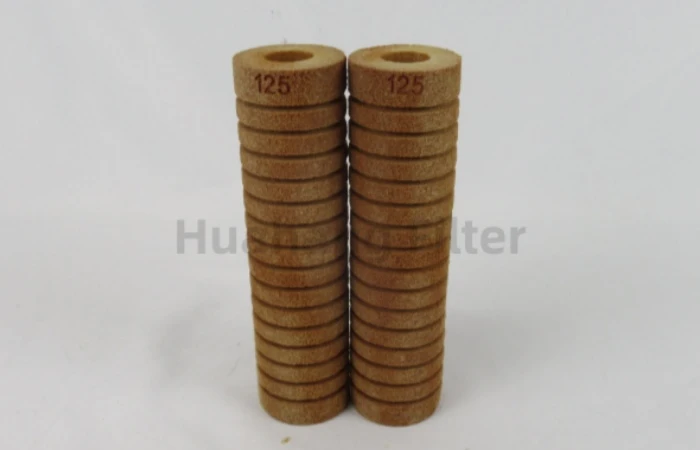
What Makes Phenolic Resin Filter Cartridges Different
A phenolic resin filter cartridge is a depth filter made by bonding cellulose, acrylic, polyester, or microfiberglass media with phenolic resin into a rigid porous matrix. It captures particles throughout the medium and offers high differential-pressure strength, thermal stability, and broad chemical compatibility with oils, solvents, and hydrocarbons.Best suited to hot, viscous, or chemically aggressive fluids - not potable water or hygienic applications - it remains a specialized choice for demanding industrial filtration.
Where Phenolic Resin Cartridges Earn Their Place
The application map for phenolic resin cartridges is shaped by the same properties that define the medium: heat tolerance, rigidity, and chemical resistance. The table below summarizes the major industrial sectors and the specific fluids where these cartridges are commonly specified.
| Industry | Typical fluids | Why phenolic cartridges fit |
|---|---|---|
| Paints, coatings, inks | Enamels, lacquers, varnishes, printing inks, plastisols, sealants | High viscosity and pigmented formulations demand a rigid depth structure that will not compress or release captured solids under pressure |
| Petroleum and fuels | Crude oil, fuel oil, lube oils, hydraulic fluids, kerosene, waxes, asphalts | Hydrocarbon compatibility, high dirt-holding capacity, and thermal stability for hot oil service |
| Resins and polymers | Acrylics, alkyds, epoxies, silicones, urethanes, vinyls | Viscosities up to 3,000 cP and beyond, with chemical resistance to reactive monomer streams |
| Chemical processing | Organic solvents (alcohols, ketones, ethers), amines, glycols, halogenated hydrocarbons | Broad solvent compatibility and resistance to chemically aggressive liquids |
| Industrial water and coolants | Machine coolants, process water, wastewater (non-potable) | Mechanical strength and dirt capacity in recirculating systems, though pH must be verified |
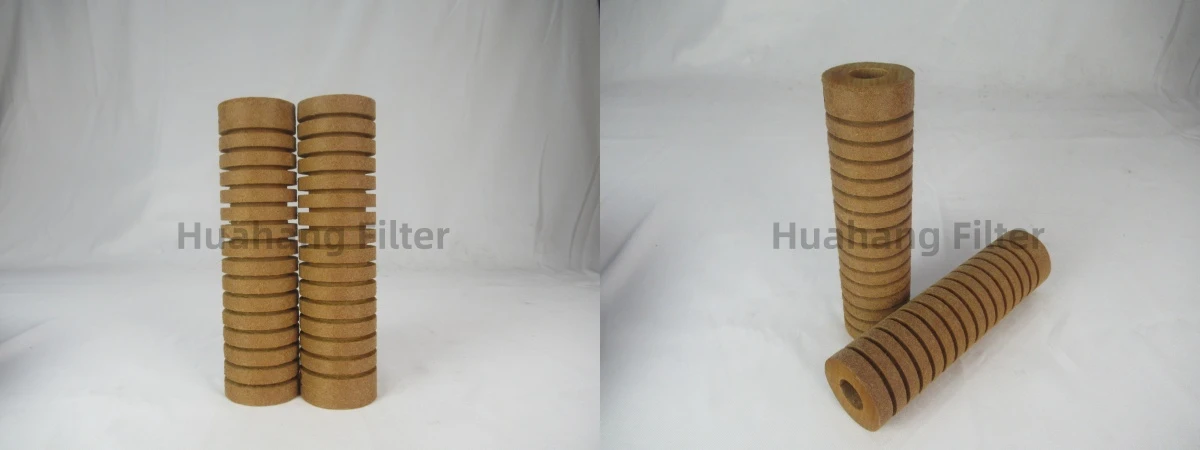
How Does a Phenolic Resin Filter Cartridge Work?
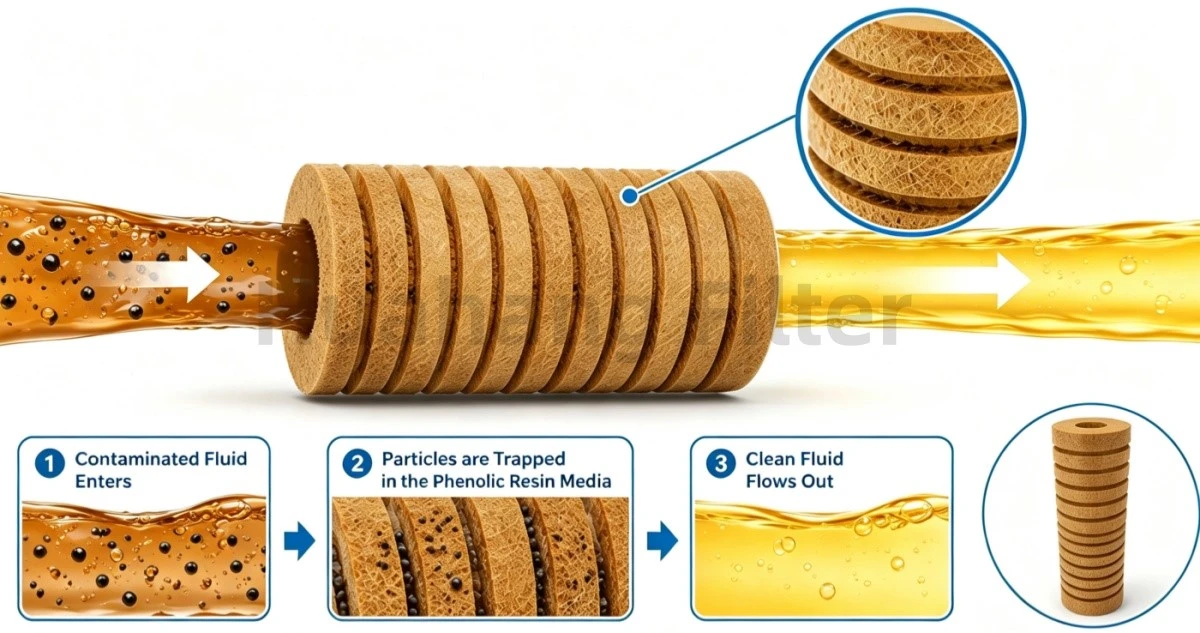
Phenolic resin filter cartridges primarily use depth filtration.
Instead of capturing most contaminants on a single flat surface, the filter provides a three-dimensional network of fibers and pores. As contaminated liquid passes through the cartridge, particles are progressively trapped throughout the depth of the filter media.
▄ Typical filtration process
Contaminated liquid → coarse particle capture → deeper particle retention → filtered liquid
The outer layers generally capture larger particles first. Smaller particles then move deeper into the cartridge and are retained by progressively tighter filtration structures.
This design is particularly useful when the process contains a relatively high concentration of suspended solids because the available internal volume can be used for contaminant storage.
The rigid resin-bonded structure also helps maintain pore geometry and mechanical stability when the filter experiences increasing differential pressure.
Key Advantages of Phenolic Resin Filter Cartridges
The main reason to choose a phenolic resin filter cartridge is not simply its micron rating. Its value comes from the combination of depth filtration, rigidity, contaminant-holding capacity, and compatibility with demanding industrial processes.
High Dirt-Holding Capacity
Because contaminants can be retained throughout the depth of the media, resin-bonded cartridges can accommodate significant amounts of particulate contamination before reaching the replacement differential pressure.
High Mechanical Strength
The cured resin structure provides rigidity to the filter media. This helps the cartridge maintain its physical structure under pressure and during the filtration of viscous liquids.
Stable Filtration Performance
A rigid filter structure can provide more consistent performance than a highly compressible depth medium under certain operating conditions.
Good Performance with Viscous Fluids
Phenolic resin filter cartridges are frequently selected for industrial liquids where viscosity is higher than that of ordinary water-based process streams. However, actual flow performance must always be evaluated against the fluid's viscosity and operating temperature.
Typical Specifications of Phenolic Resin Filter Cartridges
There is no single universal specification for phenolic resin filter cartridges. Specifications vary according to the manufacturer, media formulation, application, and housing.
Typical commercial configurations may include:
| Parameter | Typical Options |
| Filter type | Depth filtration |
| Filter media | Cellulose, acrylic, polyester or other fibers |
| Micron rating | Approximately 1–200 μm depending on design |
| Common lengths | 10", 20", 30", 40" |
| Outside diameter | Approximately 63–65 mm for common designs |
| End connections | DOE, 222, 226 and customized options |
| Construction | Grooved, wound or graded-density structures |
Note: The micron ratings, dimensions, and temperature limits can vary significantly, so the manufacturer's actual technical data should always take priority over generic specifications.
How to Choose the Right Phenolic Resin Filter Cartridge
Selecting a phenolic resin filter cartridge should begin with the process conditions, rather than the cartridge name or micron rating alone.
▄ Identify the Filtered Liquid
First determine exactly what fluid needs to be filtered.
Examples include:
- Paint
- Ink
- Epoxy resin
- Adhesives
- Lubricating oil
- Hydraulic oil
- Coolant
- Solvents
- Chemical solutions
- Petrochemical fluids
The fluid determines the required media, resin formulation, seal material, temperature resistance, and chemical compatibility.
▄ Determine the Required Micron Rating
Micron rating is one of the most important specifications, but it should not be considered independently.
Phenolic resin cartridges are available in a broad range of filtration ratings, with commercial products commonly covering approximately 1–200 μm, depending on the design.
A smaller micron rating is not automatically better.
If the selected filter is unnecessarily fine, it may create:
- Higher initial pressure drop
- Faster clogging
- Lower flow
- Shorter service life
- Higher operating costs
The correct micron rating should be based on the required downstream cleanliness and the contaminant-size distribution.
▄ Consider Fluid Viscosity
Viscosity is particularly important for paint, resin, adhesive, ink, and oil filtration.
As viscosity increases, the pressure drop across the cartridge generally increases at the same flow rate. Therefore, a cartridge that performs well with water may not provide the same flow performance with a high-viscosity resin.
For viscous fluids, consider:
- Higher operating temperature where permitted
- Larger filtration area
- Lower flow velocity
- Appropriate micron rating
- Longer cartridge configuration
- Multiple cartridges in parallel
- Acceptable differential pressure
This is one reason resin-bonded depth cartridges are often used in industrial processes involving viscous liquids.
How to Extend Phenolic Resin Filter Cartridge Service Life
Several measures can help increase cartridge service life.
▄ Use the correct micron rating
Avoid selecting a cartridge simply because it has the smallest available micron rating.
▄ Optimize filtration area
If the cartridge is reaching its pressure limit too quickly, increasing the number or length of cartridges may reduce the loading rate per element.
▄ Control upstream contamination
An upstream pre-filter can remove larger particles before they reach the finer cartridge.
▄ Monitor differential pressure
Tracking ΔP provides a better indication of actual filter loading than replacing cartridges according to a fixed schedule.
▄ Consider fluid temperature and viscosity
Where permitted by the process and filter specifications, controlling viscosity can improve flow and reduce unnecessary pressure drop.
Conclusion
A phenolic resin filter cartridge is more than a conventional depth filter. Its rigid resin-bonded structure makes it a practical option for industrial processes involving significant particulate loading, viscous liquids, coatings, inks, resins, oils, adhesives, and selected chemical fluids.
However, the best cartridge cannot be selected from micron rating alone.
A reliable selection should consider:
Fluid + contaminants + micron rating + viscosity + flow rate + temperature + pressure + chemical compatibility + cartridge dimensions
For demanding industrial filtration, the goal is not simply to find the finest filter. The goal is to find the cartridge that provides the required filtration performance while maintaining acceptable flow, pressure drop, service life, and operating cost.
For custom or replacement applications, providing the existing cartridge dimensions, operating conditions, filter rating, and application details allows the filter manufacturer to recommend a more suitable phenolic resin filter cartridge.