


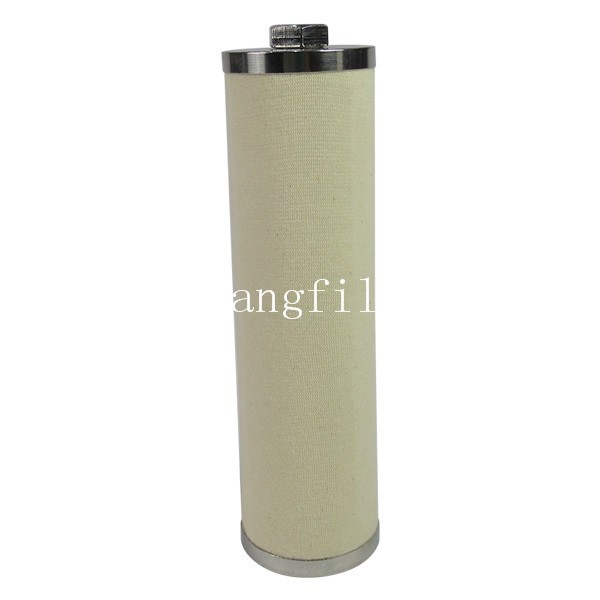
Natural Gas Coalescer Filter Element 60x208
Products Description
The Natural Gas Coalescer Filter Element (60 mm OD × 208 mm) is a high-efficiency gas–liquid separation cartridge engineered to remove sub-micron liquid aerosols - water, hydrocarbon condensate, compressor lube oil, and amine or glycol carryover - from natural gas and fuel gas streams before they reach compressors, dehydrators, molecular sieves, burners, and downstream instrumentation.
The element uses a borosilicate glass microfibre coalescing medium in a depth-filtration configuration, combined with a rapid-drainage outer layer and stainless steel end caps and support skeleton. Gas flows from the inside to the outside of the cartridge: aerosol droplets are intercepted on the microfibre surfaces, merge into larger droplets within the media depth, and are released at the outer drainage layer, from which they detach and fall by gravity to the housing sump.

Technical parameter
| Parameter | Specification |
| Filter Type | Natural Gas Coalescer Filter Element |
| OD | 60 mm |
| Height | 208 mm |
| Filter Material | Composite materials |
| Flow Direction | Inside to outside |
| End Caps | 304 Stainless steel |
| Support Core |
304 Stainless steel |
| Origin | Henan, China |
Note: Coalescer performance is not a property of the element alone. Liquid loading, gas velocity through the housing, annular velocity, settling distance, and drainage path all determine whether the rated efficiency is achieved in service. Huahang supplies sizing reference data and can review the housing flow envelope against the element rating on request.
manufacturer: huahang filter
Huahang Filter has manufactured industrial filtration elements since 2003 from a 26,000 ㎡ facility in Xinxiang, Henan Province. The company holds ISO 9001:2015 and CE certifications and is recognized as a Henan Provincial "Specialized and Sophisticated" SME with multiple national patents. Coalescer and separator elements for removing water and liquid aerosols from oil, fuel, and gas streams are an established product line, supported by in-house testing and export experience to more than 120 countries.
For OEM replacement programs, elements are manufactured to drawing, sample, or OEM part number, with verification data available for dimensional conformance and flow-direction integrity.

01
True Factory-Direct Custom Manufacturing
Every element is designed and produced in our ISO 9001 certified facility. No brand markups, no trading middlemen.
02
20+ Years of Filtration Expertise
Since 2003, Huahang has specialized in wound, pleated, and depth air filter elements for industrial ventilation, compressed air, and equipment protection applications worldwide.
03
Graded-Density Winding Control
We control winding tension, layer count, and fiber distribution to achieve consistent graded-density structure and repeatable filtration performance.
04
Strict Quality Control
Raw material traceability, in-process inspections, and final dimensional verification ensure consistent, reliable quality for every filter.
Our certificates:

Application
- Fuel gas to engines and turbines. Removal of compressor lube oil carryover and hydrocarbon condensate before combustion, protecting fuel nozzles, valves, and combustion stability in power generation and industrial engine service.
- Natural gas dehydration and molecular sieve protection. Coalescing free liquids upstream of glycol contactors, desiccant beds, and molecular sieves extends bed life and prevents capacity loss from liquid flooding.
- Amine and glycol contactor overheads. Capture of amine or glycol aerosol carryover that would otherwise foul downstream compressors, exchangers, and sulfur recovery units.
- CNG and gas distribution stations. Liquid removal at pressure reduction and metering stations, city gate stations, and CNG fueling station coalescers where a compact element format is required.
- Analyzer and sample conditioning systems. Protection of analyzers from liquid slugs and aerosols in sample gas streams; the 60 × 208 mm format suits sample panels and slipstream cabinets.
- Refrigeration and evaporator overhead gas. Separation of entrained refrigerant liquid or evaporator overhead droplets in compression and condensation circuits.
- Compressed air and technical gas polishing. Removal of oil aerosols and condensed water from compressed air or technical gas where the gas is subsequently used in instruments, breathing air, or process contact.
FAQ
Q: The element is rated at 99.99% efficiency, yet liquid is still reaching downstream equipment. What is the most likely cause?
A:
* Efficiency rating is a sizing-condition value, not a guarantee at any flow. A coalescer achieves its rated aerosol removal only when media velocity, annular velocity, liquid loading, and settling distance are within the design envelope. When the housing is undersized or operated above its rated flow, droplets are re-entrained before they can drain.
* Liquid loading above design. A coalescer sized for dispersed aerosols can be overwhelmed by liquid slugs or by a sudden increase in condensate or amine carryover. The element may be intact, but the housing sump and drainage capacity become the limiting factor.
* Drainage failure. If the drain is blocked, undersized, or subject to back-pressure, coalesced liquid accumulates in the housing and is eventually swept downstream. Drain type - manual, float-automatic, or electronic - and drain-line sizing are part of the separation system, not accessories.
* Element bypass or seal failure. A missing or damaged gasket, a collapsed cartridge, or an incorrectly seated end cap allows gas to bypass the coalescing medium entirely, producing carryover with little or no pressure-drop signal. Diagnostic sequence: confirm housing ΔP trend, inspect the drain for continuous liquid flow, verify seal and end-cap seating, and compare actual gas flow against the element's rated flow envelope before replacing the element.
Q: How do I know whether the element needs changing, and why is a fixed change-out interval unreliable?
A:
* Use ΔP, not calendar time. The recommended change-out differential is typically around 1.0 bar / 15 psi, with a maximum element ΔP of roughly 50 psid depending on the element class and housing limit. A coalescer that has not reached its ΔP limit may still be performing, while a calendar-based change can discard a serviceable element.
* High ΔP without liquid breakthrough can indicate solids loading. Particulate captured on the coalescing medium raises ΔP independently of liquid removal; in that case the element is flow-limited by solids, and the upstream particulate filter or the coalescer's solids-holding capacity should be reviewed.
* Low ΔP with carryover is a different failure mode. This pattern points to bypass, seal failure, drainage failure, or re-entrainment rather than a loaded element. Replacing the element without correcting the root cause will reproduce the problem.
* Trending matters more than a single reading. A rising ΔP trend at constant flow and temperature is the reliable loading signal; a step change suggests a process upset, slugging, or mechanical damage.
* Post-change verification: record the clean ΔP at commissioning flow and compare it to the previous clean baseline. A clean ΔP significantly higher than baseline may indicate a wrong micron grade or an incorrectly oriented element.
Q: What flow and pressure-drop information is needed to select the correct coalescer element, and why is "same dimensions" not enough?
A:
* Dimensions alone do not define separation performance. The 60 × 208 mm envelope fixes the mechanical fit, but the coalescing medium grade, pleat density, drainage-layer design, and seal configuration determine whether the element will remove the target droplet size at the actual gas flow.
* Gas flow and operating pressure. Coalescer sizing is governed by actual volumetric flow at operating pressure, not standard volumetric flow. A housing that is adequately sized at low pressure can become velocity-limited at high pressure because the actual volumetric flow falls while mass flow and liquid loading remain unchanged.
* Liquid loading and droplet size distribution. The coalescer must be matched to the incoming liquid concentration and the droplet size spectrum. A stream dominated by fine aerosols below 0.3 μm requires a finer coalescing grade than a stream with larger entrained droplets, and a stream with slugs requires drainage and sump capacity beyond the element itself.
* Allowable clean ΔP and housing velocity limits. The element must deliver the required removal at a clean ΔP that fits the system budget, while keeping media velocity and annular velocity below the thresholds at which re-entrainment occurs.
* What to send Huahang for a sizing review: gas composition and operating pressure/temperature, actual flow rate (Nm³/h or SCFM at operating conditions), liquid loading estimate (ppm or mg/m³), target outlet liquid content, housing drawing or model, and the existing element's OEM part number and ΔP history.
Q: What causes re-entrainment, and how can it be avoided without replacing the element?
A:
* Re-entrainment is coalesced liquid being picked back up by the gas after it has left the medium. It is distinct from poor coalescing efficiency: the medium may be capturing droplets correctly, but the drainage and velocity conditions allow the separated liquid to return to the gas stream.
* The primary driver is gas velocity through the housing. If the actual volumetric flow exceeds the housing's rated flow for the element grade, the gas shear at the element surface and in the annular space is sufficient to detach and carry droplets that would otherwise drain.
* Drainage-layer design and element orientation matter. An element with a dedicated rapid-drainage outer layer promotes continuous dripping and reduces the residence time of liquid on the surface; an element without this layer, or one installed in the wrong flow direction, is more prone to re-entrainment.
* Liquid loading spikes and slugs can overwhelm drainage capacity. A coalescer sized for steady-state dispersed droplets may flood during a slug; the element itself is not necessarily at fault, but the housing sump and drain must be able to remove the liquid before the next flow cycle.
* Mitigation without element replacement: reduce flow to within the housing's rated envelope, verify and clear the drain path, confirm vertical orientation, and check that the seal and end caps are not bypassing. If the housing is fundamentally undersized for the flow, the durable fix is a larger housing or a different element geometry - not a tighter micron rating.
Hot Tags: Natural Gas Coalescer Filter Element 60x208 manufacturers, buy Natural Gas Coalescer Filter Element 60x208, Coalescence Filters, Coalescer Filtration Filter, PALL Coalescer Filter, Coalescing Filter Oil Water, Customize Coalescer Filters Cartridge, Natural Gas Coalescer Filter
Send Inquiry
