
If you have ever had to deal with a filter that clogs too fast, collapses under pressure, or lets particles through that should have been caught, you understand the value of choosing the right element. A wedge wire filter element is a proven solution for many demanding liquid filtration applications. It handles solids-laden streams, stands up to high pressures, and can be cleaned and reused many times.
But selecting the right one for your specific system is not a matter of picking a part number from a catalog. You need to consider several factors: the size of the particles you need to capture, the flow rate of your system, the chemical environment, and how the filter will be cleaned. Let me walk you through each factor so you can make the right choice.
What is a wedge wire filter element
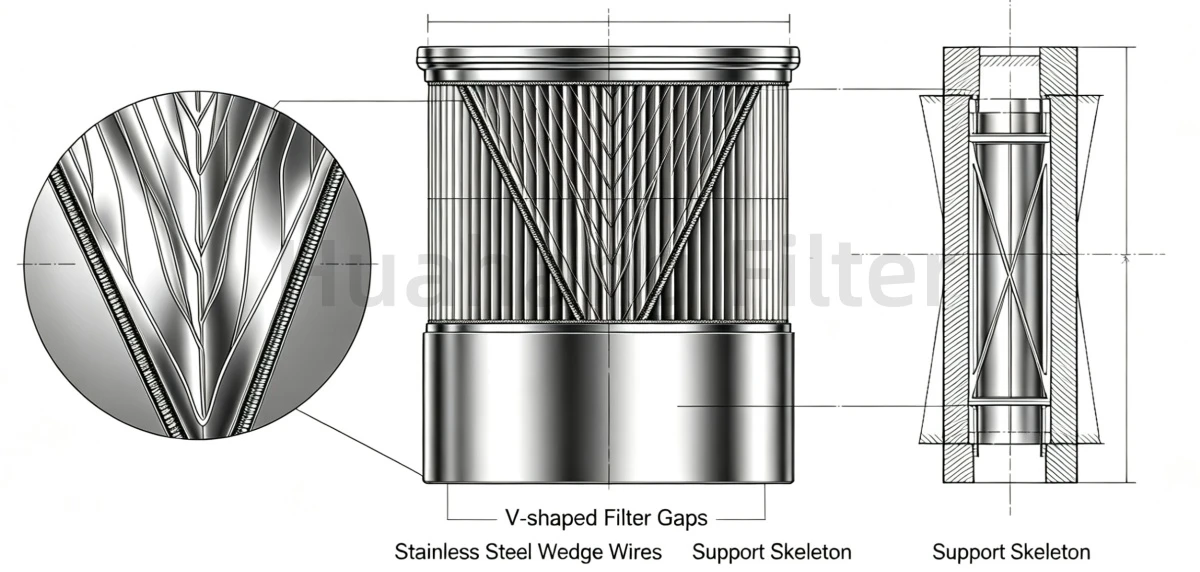
A wedge wire filter element, also sometimes called a Johnson screen or Vee‑wire filter, is a cylindrical filter made by welding V‑shaped stainless steel wires onto a set of support rods. The wires run around the circumference of the cylinder, and the gaps between them form continuous slots. These slots are the filtering openings.
The V‑shape is the key. The narrow side of the V faces the incoming flow, so particles that are too large to fit through the slot get trapped on the surface. The wider side of the V faces the inside of the element, allowing captured particles to be easily dislodged when the filter is cleaned - typically by backwashing. This design gives wedge wire filters a self-cleaning advantage over many other filter types.
Unlike sintered metal filters, which rely on three-dimensional pore channels for depth filtration, wedge wire is a surface-type filter with a defined slot opening. Unlike woven wire mesh, which can deform under pressure, a wedge wire element is rigid and self-supporting because the wires are welded to the support rods rather than merely woven together.
Slot sizes range from as fine as 20 microns up to several millimeters, depending on the application. Materials are almost always stainless steel - commonly 304 or 316L - but other alloys are available for highly corrosive or high-temperature environments.
Key Factors to Select the Right Wedge Wire Filter Element
1. Filtration Requirement & Particle Size
The first step is identifying your filtration target:- Fine filtration: 25–100 microns
- Medium filtration: 100–500 microns
- Coarse screening: 500–5000 microns
2. Slot Size (Critical Selection Parameter)
Slot size determines filtration accuracy and flow performance.
Smaller slots = higher precision but higher pressure drop
Larger slots = higher flow capacity but lower filtration precision
ℹ️ Best practice: select a slot slightly smaller than the particle size you need to remove.
3. Material Selection (Stainless Steel Grade)
Material directly affects corrosion resistance and lifespan.
| Material | Application |
|---|---|
| SS304 | General industrial filtration |
| SS316L | Chemical, marine, high-corrosion environments |
| Duplex Stainless Steel | High-pressure & heavy-duty applications |
| Special alloys | Highly aggressive chemical conditions |
⇒For most industrial applications, SS316L wedge wire filter elements are recommended.
4. Flow Rate and Pressure Drop
System performance depends on balancing flow capacity and pressure loss.
- Larger surface area = higher flow rate
- Smaller slots = higher pressure drop
- Longer filter elements = increased capacity
Proper hydraulic design ensures stable long-term operation.
5. Filter Structure and Design Type
Different systems require different wedge wire configurations:
- Cylindrical filter cartridges
- Basket filter elements
- Conical wedge wire screens
- Flat panel screens
- Custom-designed filtration components
👉 Selection depends on installation space and system layout.
6. Mechanical Strength Requirements
Industrial systems often operate under high pressure and heavy load conditions.
Important design factors:
- Wire profile thickness
- Support rod spacing
- Welding strength
- Reinforced structure design
Strong mechanical integrity ensures long-term stability.
7. Self-Cleaning and Maintenance Options
To reduce downtime and maintenance costs, consider:
- Backwash-compatible wedge wire filters
- Rotary self-cleaning systems
- Easy-disassembly designs
- Anti-clogging slot structure
👉 Ideal for wastewater treatment and high-solid content applications.
8. Operating Environment
Environmental conditions affect material selection and durability:
- High temperature → heat-resistant stainless steel
- Corrosive fluids → SS316L or duplex steel
- Outdoor installation → anti-corrosion surface treatment
Applications of Wedge Wire Filter Elements
Our wedge wire filter elements are widely used in:
- Water treatment & wastewater filtration
- Oil & gas separation systems
- Mining and mineral processing
- Chemical processing plants
- Industrial liquid-solid separation
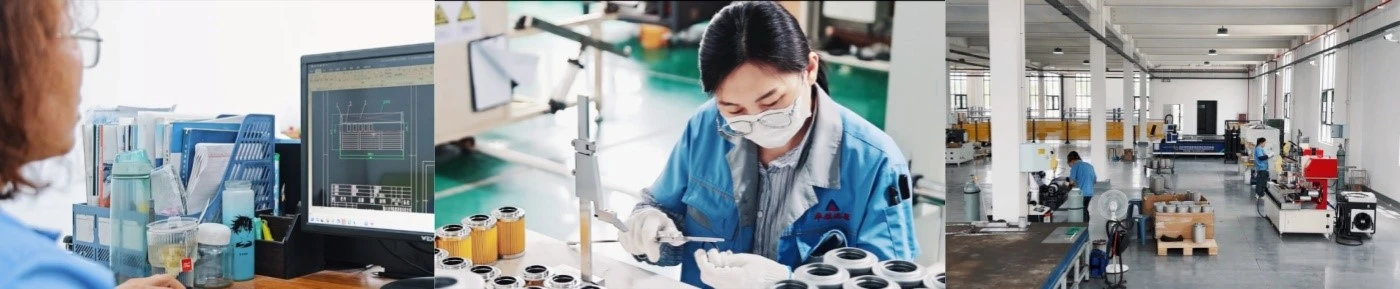
At Huahang Filter, we have manufactured wedge wire filter elements for water treatment, mining, chemical processing, and other industrial applications. If you have an existing wedge wire element that needs replacement - or if you are installing a new system and need a custom element - send us your specifications or a sample. We will help you select the right slot size, material, and configuration for your system, and provide a factory‑direct quote.
Not sure which wedge wire filter element your system needs? Contact us with your flow rate, particle size range, and fluid type. We will recommend a specification and provide a sample for testing.